MOLD ENGINEERING / BUYER’S GUIDE
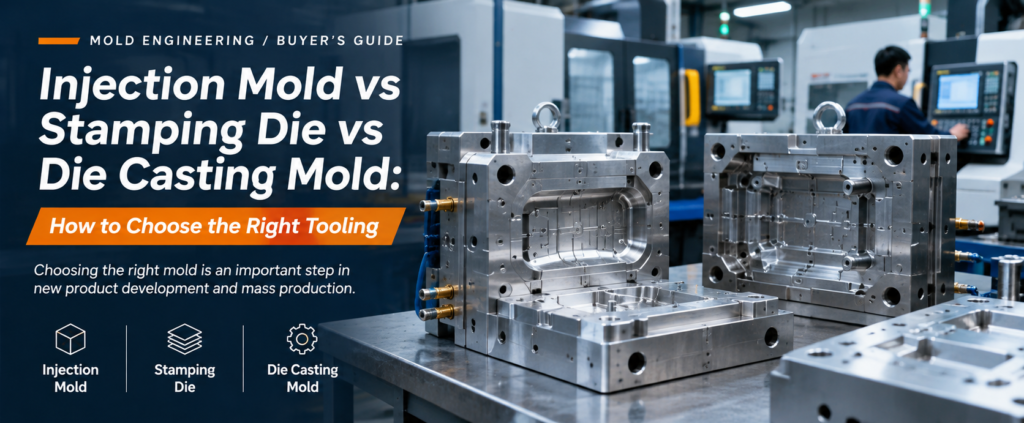
Injection Mold vs Stamping Die vs Die Casting Mold: How to Choose the Right Tooling
Choosing the right mold is an important step in new product development and mass production.
Injection molds, stamping dies, and die casting molds are designed for different materials, product structures, and manufacturing processes. Choosing the wrong process may increase tooling costs and affect production efficiency and product consistency.
This guide explains the main differences and helps you determine which custom tooling solution is suitable for your product.
What Are the Differences Between Injection Molds, Stamping Dies, and Die Casting Molds?
Injection Molds: Mainly for Plastic Products
An injection mold is used to produce plastic parts. Molten plastic is injected into a mold cavity, cooled, and formed into the required shape.
Typical applications include:
- Automotive plastic parts
- Electronic housings
- Plastic connectors
- Caps and small plastic components
- Appliance components
- Industrial plastic parts
For high-volume production, multi-cavity injection molds can produce several parts in one cycle and improve production efficiency.
When discussing a project with an injection mold manufacturer, key factors to confirm include material type, shrinkage, cooling, gate position, demolding structure, and product surface requirements.
Stamping Dies: Mainly for Sheet Metal Forming
A stamping die is used with a press to punch, cut, bend, draw, or form sheet metal into the required shape.
Typical applications include:
- Automotive metal parts
- Metal brackets
- Metal clips
- Electrical components
- Hardware components
- Metal housings
Stamping die design should consider material thickness, die clearance, forming steps, springback, and dimensional stability.
For high-volume production, a stamping die manufacturer may recommend progressive dies, depending on the product structure and production requirements.
Die Casting Molds: Mainly for Aluminum and Zinc Alloy Parts
A die casting mold is used to form parts from aluminum, zinc, and other suitable alloys. Molten metal is injected into the mold cavity under pressure to form the metal part.
Common applications include:
- Automotive components
- Motor housings
- Metal enclosures
- Mechanical parts
- Industrial hardware
Because die casting operates at high temperatures, a die casting mold manufacturer must consider gating, venting, cooling, and thermal balance during mold design.
The main distinction is the material and forming process:
- Plastic parts: Usually require injection molds.
- Sheet metal parts: Usually require stamping dies.
- Aluminum and zinc alloy parts: Are often suitable for die casting molds.
How Do You Choose the Right Mold for Your Product?
Start With the Product Material
Material is usually the first factor to consider.
A plastic housing may require injection molding, while a similar housing made from aluminum alloy may require die casting.
The mold type should be selected according to the material and manufacturing process, not only the product appearance.
Consider the Product Structure
Deep cavities, thin walls, holes, undercuts, complex surfaces, and other features can directly affect mold design.
Even products made from the same material may require different tooling solutions because of structural differences.
Consider the Expected Production Volume
Expected production quantity also affects the mold solution.
For long-term mass production, buyers should consider:
- Production efficiency
- Mold stability
- Maintenance requirements
- Number of parts produced per cycle
- Automation needs
For example, small plastic parts with high production demand may benefit from multi-cavity injection molds.
Define Precision and Surface Requirements
Critical dimensions should be clearly defined before mold manufacturing begins, especially when they affect assembly or product performance.
If the product has specific texture, polishing, appearance, or assembly requirements, these should be communicated during the mold design stage.
Why Can Mold Quotations for the Same Product Be Very Different?
Two mold quotations for the same product may be very different.
The price depends on more than mold size. It can also be affected by:
- Mold complexity
- Number of cavities
- Precision requirements
- Mold material
- Machining difficulty
- Expected production volume
- Special tooling structures
For this reason, buyers should not compare mold quotations based on price alone.
A lower-cost mold that cannot support stable mass production may lead to higher maintenance, adjustment, and production costs later.
The mold structure and manufacturing requirements should always be compared together with the price.
What Information Should You Provide Before Custom Mold Development?
Providing complete project information helps the mold manufacturer evaluate the tooling solution and quotation more accurately.
Important information usually includes:
- 2D drawings or 3D files: Show the product dimensions and structure.
- Product sample: Provide a sample if one is available.
- Product material: Specify the intended plastic, metal, or alloy.
- Material thickness: Include this information for stamping parts.
- Alloy type: Specify the alloy for die casting parts.
- Expected production volume: Share the estimated annual volume or order quantity.
- Critical dimensions: Identify dimensions that affect assembly or product performance.
- Surface and appearance requirements: Explain any texture, polishing, or visual requirements.
- Other special production requirements: Describe any additional project needs.
If complete drawings are not yet available, a product sample can also be used for an initial project discussion.
How Do You Start a Custom Mold Project?
A custom mold project usually starts with your product information.
Once the drawing, sample, material, production quantity, and key requirements are available, the appropriate manufacturing process and mold structure can be evaluated.
As a custom mold manufacturer, Hanhai Mold provides tooling according to customer drawings, samples, and production requirements, including:
- Custom injection molds
- Custom stamping dies
- Custom die casting molds
- Custom molds for heating radiators and related components
LET’S TALK TOOLING
Discuss Your Custom Mold Project With Hanhai Mold
Developing a new product or looking for a mold manufacturer in China?
Send us your drawing, 3D file, or sample, along with your product material, expected production volume, and key requirements. We can evaluate your product structure and production needs to help identify a suitable custom mold solution before moving forward with the project.