MOLD ENGINEERING / BUYER’S GUIDE
Why Does Mold Cooling Directly Affect Injection Molding Cycle Time and Product Quality?
Understand how cooling design influences cycle time, dimensional stability, and the consistency of plastic parts.
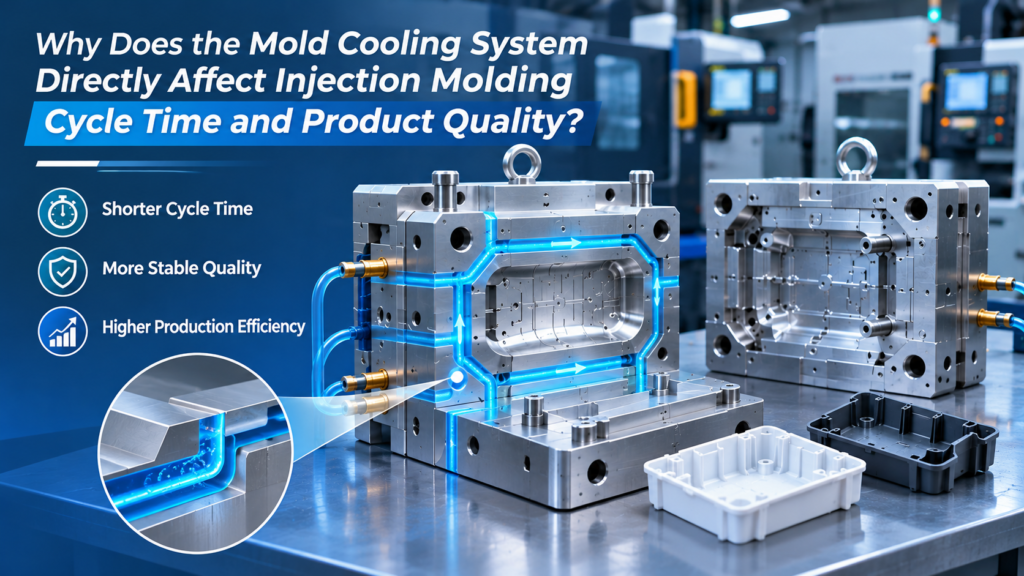
Cooling is a critical stage of injection molding. A well-designed injection mold cooling system can reduce cycle time, improve dimensional stability, and support consistent mass production. Poor cooling design, by contrast, may cause warpage, uneven shrinkage, longer cycles, and inconsistent part quality.
Why Does the Cooling System Directly Affect Injection Molding Cycle Time?
How Does Cooling Time Affect Each Molding Cycle?
After molten plastic fills the mold cavity, the part must cool until it is stable enough to be ejected without damage.
If cooling takes too long, the total molding cycle becomes longer, reducing the number of parts produced in a given period.
An efficient injection mold cooling system helps the part reach an appropriate ejection temperature sooner while maintaining product quality.
How Does Cooling Efficiency Affect Overall Production Capacity?
Shorter, more consistent molding cycles can improve overall production efficiency.
In high-volume manufacturing, even a small reduction in cycle time can make a noticeable difference across thousands of production cycles.
For this reason, the injection mold cooling system should be considered during mold development, rather than treated as an issue to fix after the mold is finished.
What Product Quality Problems Can Uneven Cooling Cause?
What Causes Warpage, Uneven Shrinkage, and Dimensional Errors?
When one area of a plastic part cools faster than another, different sections may shrink at different rates.
This can lead to:
- Warpage
- Uneven shrinkage
- Dimensional variation
- Part deformation
- Assembly problems
For precision plastic components, these variations may affect how the finished part fits and functions. A poorly balanced injection mold cooling system can increase the risk of these defects.
Why Do Local Temperature Differences Affect Molding Stability?
Hot spots in the mold can keep certain areas of the part soft for longer.
This may cause unstable ejection, fluctuating dimensions, and differences between parts produced in successive cycles.
A well-balanced injection mold cooling system helps reduce these temperature differences and improve process repeatability.
What Should a Good Mold Cooling System Consider?
How Should Cooling Channels Match the Product Structure?
Cooling channels should be planned around the part's shape, wall thickness, cavity depth, and areas where heat tends to accumulate.
Simple parts may need only a basic channel layout, while complex geometries often require more carefully positioned cooling passages.
The goal of an injection mold cooling system is to remove heat efficiently from critical areas of the mold.
Why Is Uniform Cooling More Important Than Simply Lowering Temperature?
Faster cooling does not always mean better molding results.
If some regions cool much faster than others, the finished part may still warp or shrink unevenly.
An effective injection mold cooling system must balance heat removal with a reasonably uniform temperature distribution across the mold.
Why Do Complex Parts Require Optimized Cooling Design?
Which Products Are More Likely to Develop Local Hot Spots?
Cooling deserves special attention for parts with:
- Thick sections
- Deep cavities
- Complex shapes
- Large plastic structures
- Uneven wall thickness
- Automotive or other structural plastic components
Such features can retain more heat, meaning some areas may cool more slowly than others.
When Should Conformal Cooling Be Considered?
Traditional straight cooling channels cannot always reach areas close to a complex mold cavity.
For certain parts, conformal cooling channels can follow the cavity shape more closely and help achieve a more even temperature distribution.
Whether conformal cooling is suitable depends on the part geometry, production volume, and project requirements. It is one possible option when conventional cooling layouts cannot adequately manage local heat.
Why Should Buyers Pay Attention to Cooling When Ordering a Custom Injection Mold?
How Does Cooling Design Affect Long-Term Mass Production?
A mold that produces an acceptable trial sample is not necessarily ready for stable, continuous mass production.
Buyers should also evaluate:
- Cycle time
- Cooling uniformity
- Dimensional stability
- Part-to-part consistency
- Performance during continuous operation
A properly designed injection mold cooling system can support more predictable results across repeated molding cycles.
What Should Buyers Confirm Before Mold Manufacturing?
Before starting a custom injection mold project, it helps to provide:
- Product material
- Part structure
- Wall thickness
- Critical dimensions
- Expected production volume
- Surface requirements
- Mass-production goals
This information allows the mold manufacturer to evaluate cooling requirements alongside the overall mold design.
Conclusion
The injection mold cooling system directly affects production efficiency and the quality of finished plastic parts.
Good cooling design is not only about reducing cooling time. It is also about keeping mold temperatures balanced and improving dimensional and molding stability.
For custom injection molds, cooling channels should be designed around the actual part geometry and production needs.
If you are developing a new plastic product, send us your drawing, 3D model, or sample. We can review the mold structure and cooling requirements based on your planned production volume.
LET’S TALK TOOLING
Discuss Your Custom Injection Mold Project With Hanhai Mold
Developing a new plastic part or preparing for mass production? Share your drawing, 3D file, or sample with Hanhai Mold to discuss a custom mold solution for your project.